
 ADVANI
Advani in print & media.
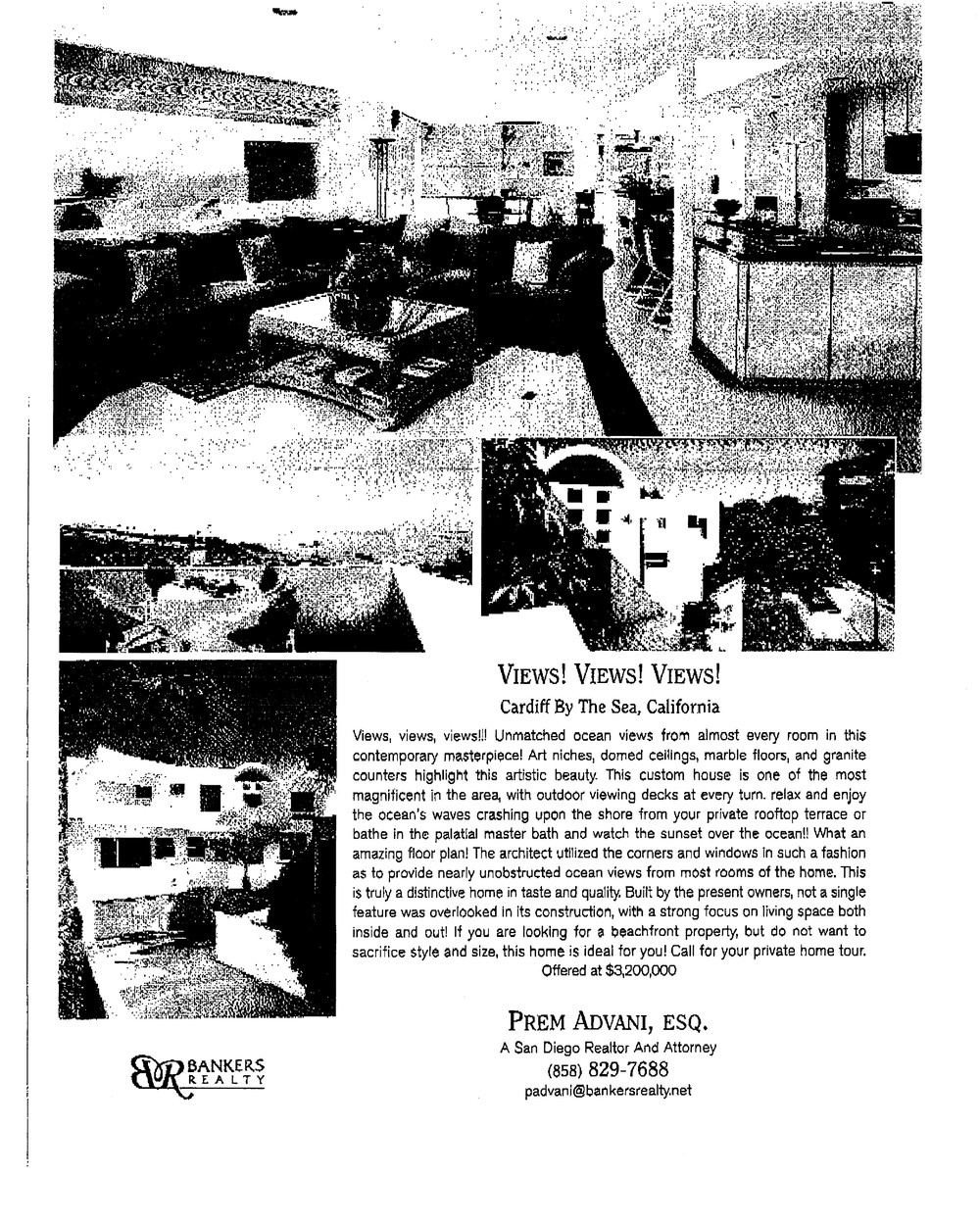
Two decades of coverage — from an under-30 spotlight in 944 Magazine to a recent sit-down with SD Voyager — pulled straight from Prem’s own archive of clippings.
Every feature, in order.
From this month’s issue of San Diego PREMIER back to a set of print ads placed in 2004 — pulled straight from Prem’s own files, most recent first. Recent San Diego PREMIER issues are broken out month by month, and Five Star Professional is broken out year by year; features that were pitched but never ran aren’t included here.




Rankings, awards & other features.
Beyond San Diego PREMIER, a running list of the industry rankings, awards, and outside features Prem’s work has picked up over the years.
Five Star Real Estate Agent
Named a Five Star Real Estate Agent by San Diego Magazine for multiple consecutive years, and invited onto the 2025 Blue Ribbon Panel to help review the following year’s award candidates.
RealTrends Verified
Named to RealTrends Verified’s 2026 Agent & Team National & State Rankings — the top 1.5% of Realtors nationwide — and again to its 2026 City Rankings for San Diego.
San Diego Real Producers
Named to San Diego Real Producers’ Top 500 (2024), its 2025 Class, and the 2026 Top 1000 — an invite-only list of the county’s top-producing agents.
Visit San Diego Real Producers →San Diego Business Journal
Selected for inclusion in the San Diego Business Journal’s Residential Real Estate Agents & Teams list.
CanvasRebel
A feature interview on the path from law to real estate, and the lessons learned building Advani Real Estate Group from the ground up.
Read the feature →Shoutout SoCal
Interviewed for Shoutout SoCal’s series spotlighting inspiring entrepreneurs and creatives across Southern California.
The Advani Brief.
A periodic read on legal, tax, and real estate strategy — sent to clients and posted here as it goes out, most recent first.
The New Laws Are Signed. Here’s What Actually Changes.
The New Laws Are Signed. Here’s What Actually Changes.

Sacramento wrapped its bill signing on September 30. Three of the new laws reach your backyard, your HOA and your lease, and most start January 1. Rates moved too. Here’s the short version.
01 · ADUs: Two backyard units, and no more fee cliff
Signed September 29. AB 956 allows up to two detached ADUs per lot, up from one, and stops HOAs from blocking ADUs that follow state law. SB 1117 ends the 750 sq ft fee cliff: impact fees now apply only to the footage above 750.
My read: That cliff is why so many backyard units are drawn at 749 sq ft. A family-sized ADU now pencils.
The move: On a deep lot, rerun the math on a second unit or a larger one. Check your city’s ordinance before you design.
02 · HOAs: Your HOA can’t veto new windows
SB 908, effective January 1, 2027, voids HOA rules that prohibit replacing windows with energy-code-compliant ones. Cities have to approve those replacements administratively, with no design hearing.
My read: Committees insisting on discontinued frames have stalled a lot of older condos and townhomes. Buyers notice drafty windows at inspection.
The move: Owners: January puts the leverage with you. Boards: update your architectural guidelines now.
03 · Landlords: The emergency rent cap now covers long leases
After a declared emergency, state law caps rent increases at 10%. Leases longer than a year were exempt. SB 1365 removes that exemption on January 1, 2027.
My read: San Diego sees wildfire and storm declarations often. Owners on 18- or 24-month leases assumed this rule didn’t apply to them.
The move: Write any planned step-ups into the lease and document capital repairs. Both are defenses for an increase above 10%.
04 · Market: 7.28%, and what it does to buying power
Freddie Mac’s 30-year average hit 7.28% on October 1, the highest since November 2023. A year ago it was 6.34%.
My read: On an $800K loan that’s about $500 more a month. The same payment now carries roughly $727K, about 9% less buying power.
The move: Sellers: price a buydown credit against a price cut, and ask your lender to run both. Buyers: shop on payment, not price.
Thinking about an ADU in 2027?
Send me your address. I’ll tell you what the new rules allow on your lot and whether a second unit is worth sketching.
Rates Went Up. That’s Not Actually the Headline.
Rates Went Up. That’s Not Actually the Headline.

Rates Went Up. That’s Not Actually the Headline.
Yesterday the Fed raised its benchmark rate a quarter point, to 3.75–4.00% — the first hike since 2023, decided unanimously, with Chair Warsh signaling more could follow through 2027. Inflation is still running above target, even after a cooler August reading, and the Committee wants a “timelier return” to 2%. Cue the headlines about expensive mortgages.
Here’s my read: the rate itself isn’t the story. The story is that almost nobody who’s actually transacting was surprised by it.
Real buyers stopped waiting on the Fed two years ago. The ones moving right now are moving because a job changed, a family grew, or a lease is up — not because they’re betting on a rate cut that keeps not arriving. That’s the same pattern from a few issues back: buyers have shifted from timing the market to managing risk, and a quarter-point hike doesn’t change what they can control — payment certainty, location, and timing their own life.
On the investment and development side, this is where I’d actually pay attention. A higher-for-longer rate environment punishes slow money. It rewards projects that can move from entitlement to shovel in months, not years — which is exactly the shift ministerial approvals under SB 79 and AB 130 created. Speed is now doing the work leverage used to do. If your deal only pencils with cheaper financing, it was already fragile; if it pencils on a faster timeline, this hike barely touches it.
And for owners sitting on real basis in a property — built, bought, or renovated in the last few years — a higher cost of capital makes every dollar of accelerated depreciation worth more, not less. Cost segregation doesn’t get less relevant when rates rise. It gets more relevant, because cash flow matters more when borrowing costs more.
At Advani, we’re leading change, not chasing it — and that applies as much to a rate decision as it does to a zoning bill. The move was priced in. What you do next is the only part that isn’t.
Sacramento’s Latest Swing at Housing Costs: AB 179
In July, Governor Newsom signed AB 179 as part of the state budget — a package aimed less at zoning (that was SB 79 and AB 130’s job) and more at the financing and fee side of the equation. The headline number: the bill’s “One-Stop Shop” financing reforms and impact-fee changes are projected to cut construction costs by $60,000–$70,000 per unit on qualifying affordable projects, by consolidating duplicative reviews into a single financing pathway.
The bill also directs real dollars: $500 million into low-income housing tax credits, $200 million into the Multifamily Housing Program, $100 million toward a disaster rebuilding fund for homeowners reconstructing after fires or floods, and an extended $900 million homelessness block grant, now with stricter local matching requirements attached.
Why it matters beyond affordable housing: every time the state strips friction out of the approval-and-financing pipeline, it resets the underwriting math for market-rate projects sitting nearby, too. Faster, cheaper reviews are contagious across a jurisdiction’s whole planning department, not just the projects the bill technically targets.
The Insurance Number Everyone in Real Estate Should Know Right Now
Starting October 15, average California FAIR Plan rates rise 29% — already talked down from the 36% originally requested, which tells you how far the state’s insurer of last resort has drifted from “temporary backstop.”
The increase isn’t uniform, and that’s the part worth knowing before your next listing or purchase: roughly a quarter of policyholders may actually see their premiums drop, in some cases significantly, while close to half are facing increases in the 30–50% range, weighted heavily by wildfire exposure and property characteristics.
For sellers, this is now a disclosure-and-pricing conversation, not a footnote — a buyer’s lender-required insurance quote can move faster than escrow. For owners of rental property, it’s a straight hit to NOI that belongs in this year’s budget, not next year’s surprise. And for anyone still assuming their homeowner’s policy will renew at last year’s number: run it before you list, not after you’re in contract.
Four Forces Quietly Reshaping Housing in 2026
Four Forces Quietly Reshaping Housing in 2026
By 2026, the housing market is no longer reacting to disruption — it is operating under a new baseline. The past several years produced a volume of housing, development, and tenant-protection laws that fundamentally altered how real estate decisions get made. What’s different now is not the pace of legislation, but the way these rules are beginning to influence behavior — by buyers, developers, landlords, and cities themselves.
The result is a market shaped less by sentiment and more by structure. Four forces, in particular, are defining how housing works this year.
1. The Shift From Discretion to Checklists
One of the most important changes in housing approvals is procedural, not philosophical. In 2026, a growing share of housing projects move forward not because a city supports them, but because the city no longer has the ability to stop them if objective standards are met.
Ministerial approvals — once the exception — are increasingly the norm. Projects that qualify under state laws now bypass public hearings, discretionary findings, and subjective design review. Approval has become a checklist exercise: height, density, affordability thresholds, setbacks, transit proximity. If the boxes are checked, the project proceeds.
This matters because discretion has historically been the largest source of risk in California housing. Uncertainty around timing, political opposition, or shifting standards often killed otherwise viable projects. In 2026, that uncertainty is shrinking — not everywhere, but in enough places to affect land values and development strategy.
Markets price certainty quickly. Sites that were previously “interesting but risky” are now simply feasible. That change is still working its way through pricing, but it is already influencing who is willing to buy land and how aggressively they underwrite projects.
2. Development Math Has Changed — Even Without Cheaper Money
Interest rates remain elevated relative to the prior decade, yet more projects are penciling in 2026 than many expected. The reason isn’t lower costs — it’s compressed timelines.
When approvals take months instead of years, carrying costs fall dramatically. Financing risk narrows. Construction pricing becomes easier to lock. In practical terms, speed has replaced leverage as the most important variable in development feasibility.
Projects that stalled in 2023 due to entitlement risk are now moving forward under clearer rules. Smaller developers, in particular, benefit from this shift. Long, uncertain approval processes disproportionately favored large firms with deep balance sheets. Faster, rule-based approvals level the field.
This doesn’t mean every project works. Construction costs remain high, labor is tight, and margins are thinner than in prior cycles. But the market is adapting. The question is no longer “Will this get approved?” but “Does this work fast enough?” That distinction is subtle — and critical.
3. Landlord-Tenant Law Is Rewriting Ownership Behavior
California’s tenant-protection framework is no longer new. What’s new in 2026 is that it is fully priced into investor behavior.
Rent caps, just-cause eviction rules, limits on deposits, and stricter requirements around owner move-ins or remodel evictions have altered the risk profile of older rental housing. The effect has not been an immediate contraction of supply, but a quiet reshuffling of ownership.
Small landlords are exiting at a higher rate, often selling to larger operators or choosing not to re-rent units after turnover. Institutional owners, by contrast, have largely adapted. Compliance systems are built in. Long-term underwriting reflects capped rent growth. New construction remains attractive due to exemption windows that delay the application of rent control.
What has changed most is the value-add playbook. Strategies that relied on rapid tenant turnover and aggressive repositioning are far less reliable. Investors are underwriting longer holds, steadier returns, and higher emphasis on operational efficiency rather than rent spikes. This is not the end of rental housing investment — it is a maturation of it, one that favors scale, patience, and precision.
4. Buyer Behavior Has Shifted From Rates to Risk
Perhaps the most misunderstood shift in 2026 is on the consumer side. Buyers are not waiting for perfect conditions — they are managing risk.
After years of volatility — rates, inflation, market corrections — buyers have recalibrated expectations. The focus is no longer on timing the market, but on controlling outcomes: monthly payment stability, lifestyle fit, long-term optionality.
This is why the market continues to bifurcate. Homes that are well-located, well-designed, and move-in ready still attract strong demand. Properties that require uncertainty — layout compromises, deferred maintenance, unclear permitting paths — face hesitation even at adjusted prices.
Buyers are more analytical, not more emotional. They are comfortable acting when the facts align, and comfortable waiting when they don’t. This creates a market that feels quieter, but is in fact more deliberate. Importantly, this behavior aligns with the structural changes elsewhere in the system: faster approvals, clearer rules, and more predictable development outcomes reduce uncertainty — and buyers reward that.
A Market Defined by Structure, Not Cycles
What distinguishes 2026 from prior periods is that housing decisions are increasingly shaped by rule sets rather than momentum. Policy changes have hardened into operating reality. Development timelines are more predictable. Ownership models are adapting. Buyers are informed rather than reactive.
This does not produce headlines. It produces steady absorption, selective activity, and a market that rewards preparation. For homeowners, this means understanding the latent potential — or future change — embedded in location and zoning. For developers and investors, it means underwriting speed and compliance as carefully as price. For buyers, it means recognizing that stability now comes from clarity, not optimism.
Housing markets don’t turn all at once. They recalibrate quietly — and then the implications become obvious in hindsight. 2026 is one of those recalibration years.
The Bill Everyone Will Be Talking About — SB 79 in Plain English
The Bill Everyone Will Be Talking About — SB 79 in Plain English
The Bill Everyone Will Be Talking About — SB 79 in Plain English
California is entering a new era of housing reform, and SB 79 may be one of the most consequential changes we’ve seen in years. If you live near a major transit stop — or own property anywhere close to rail, Coaster, Sprinter, or high-frequency bus lines — the rules for what can be built near you are about to look very different. And unlike past zoning updates, SB 79 removes much of the traditional community review process. Projects that meet the law’s criteria will move forward without discretionary hearings, neighborhood opposition, or subjective design pushback.
The goal is simple: accelerate housing production where transit already exists. But the impact on communities — especially coastal and suburban pockets — could be transformative.
Under SB 79, parcels within a half mile of a qualifying transit stop can be rezoned for significant residential density, even if the city’s zoning previously limited them to low-rise or single-family homes. Developers can build multifamily housing at heights that would have been unimaginable under local zoning — depending on proximity to the transit stop, some sites may support 4–9 stories, and in urbanized nodes, the limits can stretch beyond that with additional incentives. Parking ratios shrink dramatically or disappear entirely, and cities cannot deny compliant projects based on height, unit count, neighborhood character, or “fit.” SB 79 treats transit corridors as mandatory growth zones, not discretionary ones.
What’s just as important is what SB 79 removes: community veto power. There are no planning-commission battles, no CEQA lawsuits based on subjective impacts, and no neighborhood meetings where projects get stalled for years. If a developer meets the objective standards — transit proximity, housing type, and site eligibility — the city must issue approvals through a ministerial process. For homeowners, that means the familiar “community input” phase is no longer part of the equation. The tradeoff is speed, certainty, and scaled housing production in areas where the state has determined it’s most needed.
For buyers and residents in places like North County — think Encinitas, Solana Beach, Oceanside, and Carlsbad — this means train-adjacent parcels are entering an entirely new value category. Properties near the Coaster or Sprinter lines could see mid-rise housing appear where only small commercial buildings or old homes once stood. Investors who previously dismissed these sites due to restrictive zoning may take a second look as density becomes not just possible, but streamlined. At the same time, homeowners should understand that neighborhood change will unfold more quickly than in years past, and in many cases, without the traditional opportunity to object.
Whether you see SB 79 as progress, disruption, or both, the shift is real. The state’s goal is to place more housing closer to trains and buses, reduce traffic and emissions, and create walkable, transit-oriented communities. But for those living in these areas, the practical effect is that your neighborhood may evolve faster than you expect, and the developments you see breaking ground won’t require the usual rounds of local approval.
As cities finalize their SB 79 maps in the coming months, homeowners, buyers, and investors should pay attention. Transit proximity may soon mean more than convenience — it may be the defining factor in where growth happens next.
Buyer Sentiment Is Changing — And Faster Than You Think
Buyers are tired of waiting. For nearly two years, many sat on the sidelines watching rates rise, prices hold, and inventory stay stubbornly thin. Now the question I’m hearing is different: “Should I buy before the next wave hits?”
We’re seeing three types of buyers emerge:
- The Early Movers — they want to lock something in before competition grows again.
- The Calculated Analysts — they’re watching every micro-shift in pricing.
- The “Life Happens” Buyers — new job, new baby, divorce, upsizing — they must move regardless of rates.
What matters most? Confidence is creeping back in, especially as more buyers feel the worst is behind us. Sentiment drives momentum — and momentum shapes pricing.
What’s New for Landlords — AB 628 Explained
AB 628 — New Habitability Requirements for Rentals. Starting January 1, 2026, this law will require rental units to include working stoves and refrigerators.
Why it matters: for landlords and investors, this mandates minimal appliance standards — which impacts operating costs, maintenance budgets, and possibly tenant expectations.
What to do now: if you own or acquire rental units, budget accordingly — it may influence decisions on renovations or rent-up timing in 2026.
Primary Residence Tax Exemption: What Homeowners Should Know
The primary-residence capital gains exclusion remains one of the most powerful tax benefits available to homeowners — and it’s often misunderstood. Under current federal law, homeowners can exclude up to $250,000 of gain if single, or $500,000 if married, when selling their primary residence, as long as they’ve lived in the home for two of the last five years.
This exemption functions as a built-in profit shield. In a market where prices have risen sharply over the past decade, a large portion of your appreciation may never be taxed at all. For homeowners who have outgrown their current home, are relocating, or are considering moving equity into an investment property, this exclusion can meaningfully shift the math in your favor.
It also creates strategic timing opportunities. For owners who have lived in their property just short of the two-year mark, waiting a few months can produce a six-figure tax advantage. For those who have rented out their former residence, understanding the “two-of-five” rule is critical — the exclusion is still available if used properly, but missteps can eliminate it.
In a period where tax laws are changing, bonus depreciation is resetting, and new housing bills are reshaping the market, the primary-residence exclusion remains one of the few stable, high-impact tools available to everyday homeowners. If you’re considering selling, it’s worth modeling your projected gain early so you can plan the timing — and outcome — strategically.
The 2025 Window: Bonus Depreciation and Cost Segregation
The 2025 Window: Bonus Depreciation and Cost Segregation
The 2025 Window: Bonus Depreciation and Cost Segregation
2025 isn’t the end of bonus depreciation — it’s a reset. For property owners who understand timing, this year is a bridge to a more strategic era of tax planning. While bonus depreciation steps back from 100%, cost segregation remains the lever that lets you accelerate deductions and recover cash faster.
We’ve been conducting full studies for our clients and have offered a free preliminary estimate so owners can see the potential benefit before committing. Whether you built, purchased, or renovated property in the past few years, this could mean tens or even hundreds of thousands in accelerated deductions.
AB 130: Faster Approvals and a Clearer Path Ahead
Approved in July 2025, AB 130 is reshaping how California cities process housing applications, cutting red tape for qualifying projects and limiting discretionary delays. It’s a response to the housing crisis that prioritizes speed, clarity, and production.
We’re already implementing the framework for upcoming developments, and the early signs are promising. The key takeaway: property owners who align with the new standards — density, design, environmental consistency — can move forward with far less friction.
AB 130 isn’t just another bill. It’s a permission slip to build smarter and faster — and it’s here to stay.
The Government Shutdown’s Ripple in Real Estate
The recent government shutdown wasn’t just a headline — it slowed real business. Loan processing through FHA and VA temporarily stalled, IRS verifications delayed closings, and uncertainty crept into investor sentiment. Some lenders even paused underwriting pipelines until clarity returned.
While the market absorbed most of the shock, the real cost was time: appraisals were pushed back, 1031 exchanges got tighter, and federal housing programs froze midstream. The lesson? Policy uncertainty translates directly into project delays and holding costs.
With Washington gridlock still a risk, the takeaway is to stabilize your own timeline — control what you can, and stay liquid. Here are three steps every property owner should review before year-end:
- Accelerate Deductions — use cost segregation to capture remaining bonus depreciation before year-end.
- Optimize Entity Structure — revisit LLCs or S Corps to ensure you’re maximizing QBI and loss carryforwards.
- Leverage Energy Credits — even smaller upgrades, like HVAC, windows, or lighting, can qualify for meaningful credits.
These aren’t just compliance tasks — they’re cash-flow strategies that reward proactivity.
San Diego real estate, explained. Once a month.
New housing laws, local rules and big developments, and what they mean for your home. Written by Prem Advani, broker and attorney. Unsubscribe anytime.